
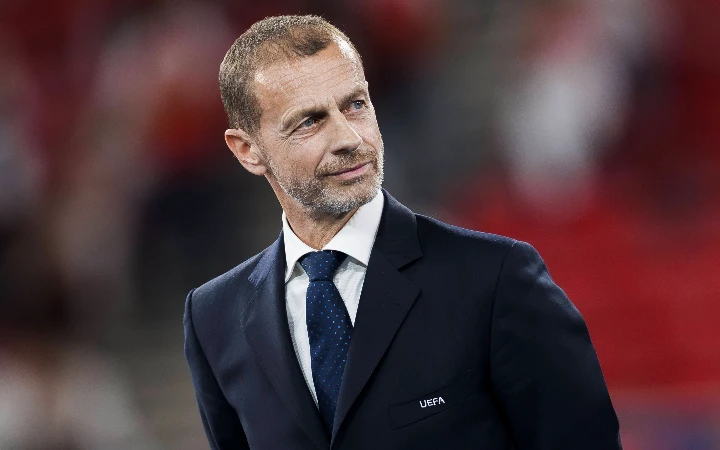
UEFA President Ceferin Skips World Cup Final as FIFA Rift Deepens
UEFA president Aleksander Ceferin did not attend Sunday's 2026 FIFA World Cup final, marking an unprecedented boycott by the head of European football. His absence highlighted worsening tensions between UEFA and FIFA over disciplinary decisions, tournament regulations and football governance.
Ceferin had attended the tournament opener between Mexico and South Africa in June. However, he opted against travelling to New Jersey for Spain's 1-0 extra-time victory over Argentina after a series of disagreements with FIFA during the competition.
Balogun decision proved the breaking point
The main source of conflict centred on FIFA's handling of United States forward Folarin Balogun. The striker was initially due to serve a one-match suspension after receiving a red card before FIFA's disciplinary committee suspended the ban.
The decision followed public confirmation by United States President Donald Trump that he had asked FIFA president Gianni Infantino to reverse the suspension. UEFA condemned the outcome, calling it "unprecedented, incomprehensible and unjustifiable" and warning that it undermined confidence in football's disciplinary process.
Reuters also reported that Ceferin's decision was influenced by disagreements over refereeing logistics and broader tournament operations. UEFA has yet to issue any further public response following the final.
Other disputes widened the divide
The Balogun controversy was only one issue separating the governing bodies. UEFA also criticised FIFA after Somali referee Omar Abdulkadir Artan was unable to enter the United States before the tournament. UEFA later appointed him to officiate next month's UEFA Super Cup between Paris Saint-Germain and Aston Villa.
Ceferin has also opposed several innovations introduced at the World Cup. These include mandatory hydration breaks, extended half-time entertainment shows and proposals to expand future World Cups to 64 teams. UEFA has also rejected FIFA's new disciplinary measures involving players who cover their mouths during confrontations. The European governing body confirmed those rules will not be introduced in UEFA competitions.
Spain crowned world champions
Despite the off-field tensions, Spain claimed their second World Cup title after defeating Argentina 1-0 following extra time. Ferran Torres scored the decisive goal in the 106th minute after Nico Williams provided the assist.
Argentina had already been reduced to 10 men when Enzo Fernandez received a second yellow card in stoppage time. Spain controlled the match, finishing with 65.1% possession, 20 shots and 12 efforts on target. Argentina managed only two shots, both arriving during extra time, while Emiliano Martinez produced 11 saves.
Standout moments from the final
Rodri completed an outstanding tournament by helping Spain dominate midfield before being named the competition's best player. Ferran Torres delivered the winning moment from the bench, while Pau Cubarsi continued his impressive campaign in defence.
The match ended in ugly scenes after the final whistle as players from both teams became involved in confrontations. FIFA has since appointed a disciplinary and ethics prosecutor to investigate the post-match incidents.
What's next?
Attention now shifts to FIFA's disciplinary investigations into the final's post-match clashes involving several Argentina players and staff. UEFA, meanwhile, will continue preparing for the UEFA Super Cup on August 12 and Euro 2028, where several of FIFA's tournament innovations are not expected to be adopted.